
Valuation
How transformer offers are actually built
Transformers are the most commonly mispriced asset on a plant electrical list, in both directions.
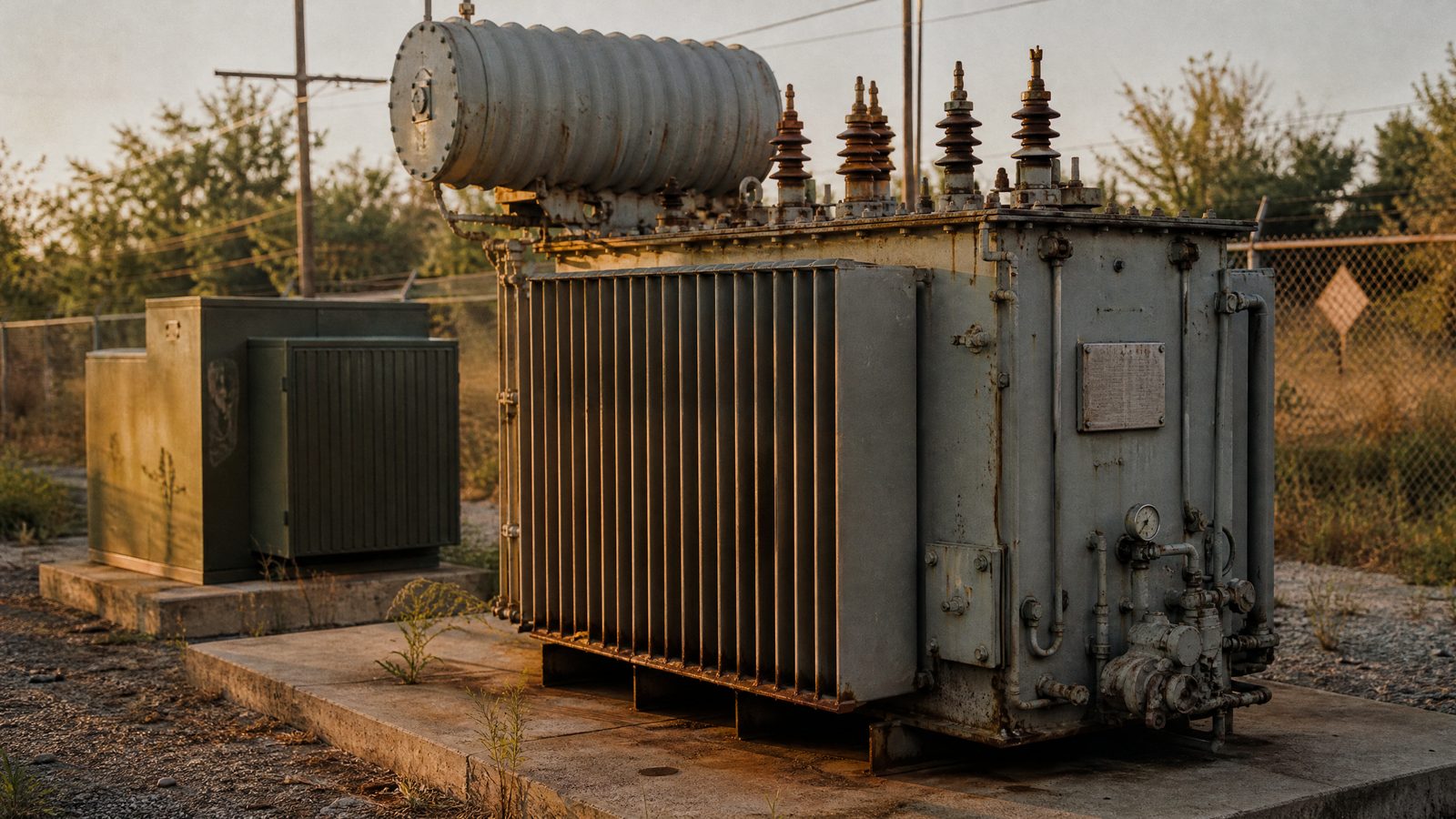
Plate 01
Size sits in a sweet spot, not on a straight line
Transformer resale value does not climb smoothly with kVA. There is a band — roughly 500 kVA through 5 MVA — where demand from industrial buyers, contractors and utilities is deepest, and units in that band move fastest at the strongest prices.
Below about 150 kVA the market is thin because new units are inexpensive and easy to procure, so small transformers usually settle near recovery value. Above roughly 20 MVA the buyer pool narrows to utilities and very large industrials, and value depends heavily on whether the specific impedance and winding configuration match a project that is live at that moment.
Plate 02
Dry-type versus liquid-filled changes everything downstream
Dry-type units avoid fluid questions entirely, which makes them simpler and cheaper to move and gives them a broad indoor market. Cast-coil units in particular hold value well. Their weakness is moisture: a dry-type that has been rained on or stored in a humid space frequently fails insulation-resistance testing, and an untestable unit is a copper transaction.
Liquid-filled units carry more copper and steel and hold value in outdoor and pad-mount applications, but the fluid drives handling cost and documentation. Both classes sell well; they just sell to different buyers, and the removal plans look nothing alike.
Plate 03
Voltage and configuration decide who can use it
A transformer only gets reused if its primary and secondary voltages fit somebody's system. Common combinations — 13.8 kV to 480 V, 4160 V to 480 V, 480 V to 208 V — have wide markets. Unusual ratios, custom taps, furnace and rectifier duty and specialty configurations shrink the buyer pool sharply, which usually means the metal sets the price.
Tap-changer type matters too. Load-tap-changing units are valuable but complex and heavy; no-load tap changers are simpler and easier to place.
Plate 04
Test history is the multiplier
Insulation resistance, turns ratio, power factor and — on liquid-filled units — dissolved gas analysis and oil quality results are what let a transformer be sold as verified rather than as-is. A recent, clean test package can be the difference between recovery value and full resale value on the same physical unit.
If you have any test history at all, send it. If you do not, it can sometimes be worth commissioning testing before sale on larger units, and we will say so when the arithmetic supports it rather than quietly buying an untested unit at an untested price.
Questions
Frequently asked
What size transformers do you buy?
From roughly 75 kVA through 50 MVA, including pad-mount, dry-type, substation, rectifier and furnace transformers, and unit substations complete with their primary and secondary sections.
Do you buy transformers that failed testing?
Yes. A failed unit is priced on core, coil and copper content rather than resale, which is still a meaningful number, particularly on larger liquid-filled units.
Is a dry-type or liquid-filled transformer worth more?
It depends on the application rather than the class. Dry-type units move easily and avoid fluid handling; liquid-filled units carry more metal and serve outdoor and pad-mount demand. Both have active markets.
Do you remove transformers from pads and vaults?
Yes, including pad-mount units, indoor vault installations and substation transformers requiring crane work. Removal is included in the purchase, with our own rigging crews and insurance.
Next
Related field notes
Transformer oil and PCB documentation, explained plainly
What PCB classification means for a transformer sale, which vintages need testing, and the documentation a seller should insist on receiving at removal.
ComplianceTaking a substation out of service and out of the ground
How substation decommissioning is sequenced, what carries recovery value, and the utility coordination that has to happen before a crew mobilizes.
ProjectsWhat used switchgear is actually worth
How a used-switchgear buyer builds a number: resale value versus copper content, which nameplates matter, and the removal costs that get subtracted before you see an offer.
ValuationForm 1 — Request for Offer
Get a Written Offer
Send the asset list, or just describe what is in the room. We come back the same business day with a written, itemized offer.
Faster: call or text 954-740-1983
Email an asset list to electricalequipmentbuyers@gmail.com
Mon–Sat, 7am–7pm ET. We never resell your contact information.