
Projects
Taking a substation out of service and out of the ground
A substation removal is a utility coordination project with a rigging job attached, and treating it in the other order is how people get hurt.
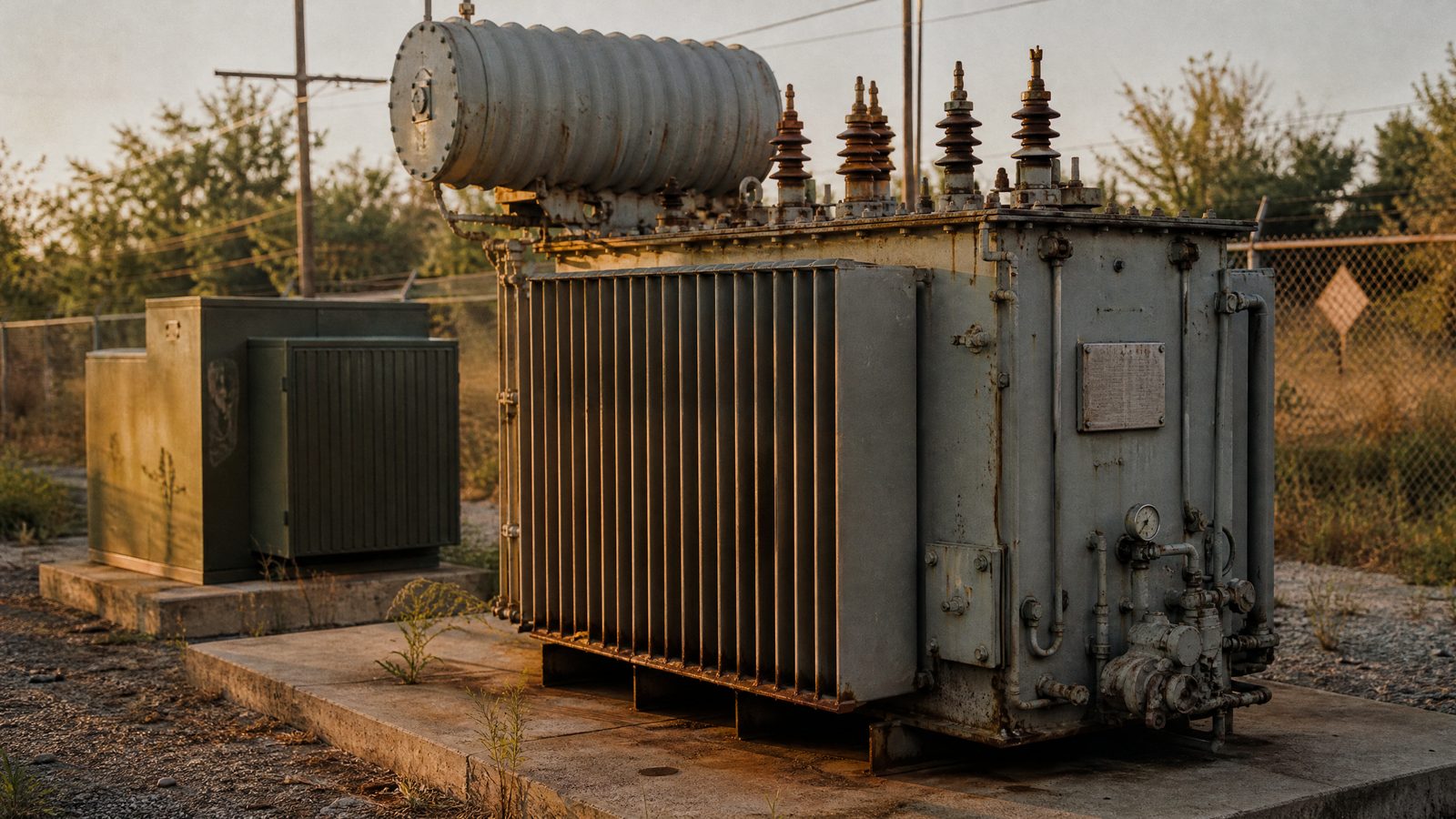
Plate 01
Coordination comes first
Nothing happens until the interconnection is addressed. That means written confirmation from the utility that the feed is isolated, clarity on ownership of every asset inside the fence, and grounding of the equipment that is being worked on. On customer-owned substations there is frequently ambiguity about where utility ownership stops, and it has to be resolved on paper.
Induced voltage on de-energized conductors near live lines is a real hazard on substation sites. Working grounds are not a formality; they are the control that makes the work survivable.
Plate 02
What carries value inside the fence
Power transformers are usually the dominant asset. Then metal-clad switchgear, oil and vacuum circuit breakers, regulators, reclosers, capacitor banks, potential and current transformers, protective relays, station batteries and chargers, and the copper in the ground grid and the control cable.
Steel structures and bus have recovery value. Relay panels with electromechanical relays sometimes have surprising resale value because utilities maintaining legacy protection schemes need matching units.
Plate 03
Environmental items to establish early
Transformer and breaker oil classification, any historical spill documentation, the condition of containment and oil-water separators, and whether the site has soil issues. Substations are frequently decades old and the environmental history is often less documented than anyone would like.
Establishing this before mobilization keeps the project from stopping at the worst moment, which is with a transformer already rigged and a truck on site.
Plate 04
Sequencing the physical work
The order is generally: verify isolation and apply grounds; recover relays, batteries and control equipment; remove breakers and switchgear; drain or prepare transformers as required and rig them out; then structures, bus and finally the ground grid and foundations if they are in scope.
Transformers set the crane requirement and therefore the schedule. Getting the crane on and off site in one mobilization is usually the difference between a profitable project and a marginal one, which is why the sequence is planned backward from the heaviest lift.
Questions
Frequently asked
Do you buy complete substations?
Yes, including power transformers, metal-clad switchgear, breakers, regulators, capacitor banks, relays, station batteries, structures and the copper ground grid.
Who handles the utility coordination?
We coordinate the isolation and grounding with the utility and the site owner, but written confirmation of interconnection status has to come from the utility itself before any work begins.
Is the copper ground grid worth recovering?
Frequently yes on larger stations, though it depends on grid depth, conductor size and site restoration requirements. It is priced as a separate line item.
How long does substation decommissioning take?
Small distribution stations run one to two weeks. Larger transmission-class stations run several weeks to a few months depending on utility windows and crane availability.
Next
Related field notes
Transformer oil and PCB documentation, explained plainly
What PCB classification means for a transformer sale, which vintages need testing, and the documentation a seller should insist on receiving at removal.
ComplianceHow to scope the electrical side of a plant shutdown
Sequencing, temporary power, what to sell versus scrap, and the documentation that keeps a decommissioning from stalling.
ProjectsWhat buyers look for in 5 kV and 15 kV equipment
Metal-clad switchgear, vacuum breakers and MV motor control: why the buyer pool is small, why values are high, and what documentation is effectively required.
ValuationForm 1 — Request for Offer
Get a Written Offer
Send the asset list, or just describe what is in the room. We come back the same business day with a written, itemized offer.
Faster: call or text 954-740-1983
Email an asset list to electricalequipmentbuyers@gmail.com
Mon–Sat, 7am–7pm ET. We never resell your contact information.