
Process
How It Works
Four steps, no surprises, and payment before anything leaves your property. This is the same sequence whether you are selling one transformer or emptying a substation.
 4 steps
- Offer
- Same business day
- Payment
- Before load-out
- Removal
- Our crews, our rigging
- Insurance
- COI on request
- Coverage
- All 50 states
- Desk
- 954-740-1983
Plate 01
1. You send what you have
A phone call, a photo of a nameplate, an asset list from a decommissioning consultant, or a single-line diagram. Any of those is enough to start. What helps most: kVA or amperage, voltage, manufacturer, breaker frame sizes and roughly how the equipment gets out of the building.
If you do not have that information, tell us where the gear is and we will walk it ourselves. Site visits are free and we do not charge for an appraisal that does not end in a sale.
Plate 02
2. We write an itemized offer
Same business day in almost every case. The offer lists each lot separately, states what we are paying for it, and states plainly what we are doing: whether we remove, who disconnects, who patches, what leaves and what stays.
You will never get a single lump number with no scope attached. That is how sellers end up arguing about backfill and floor patching after the trailers are loaded.
Plate 03
3. Lockout, then removal
Nothing gets touched until your electrician or your utility has de-energized and locked out the equipment and your representative has verified it. We work on dead gear only. That is not negotiable and it is the reason our insurance is what it is.
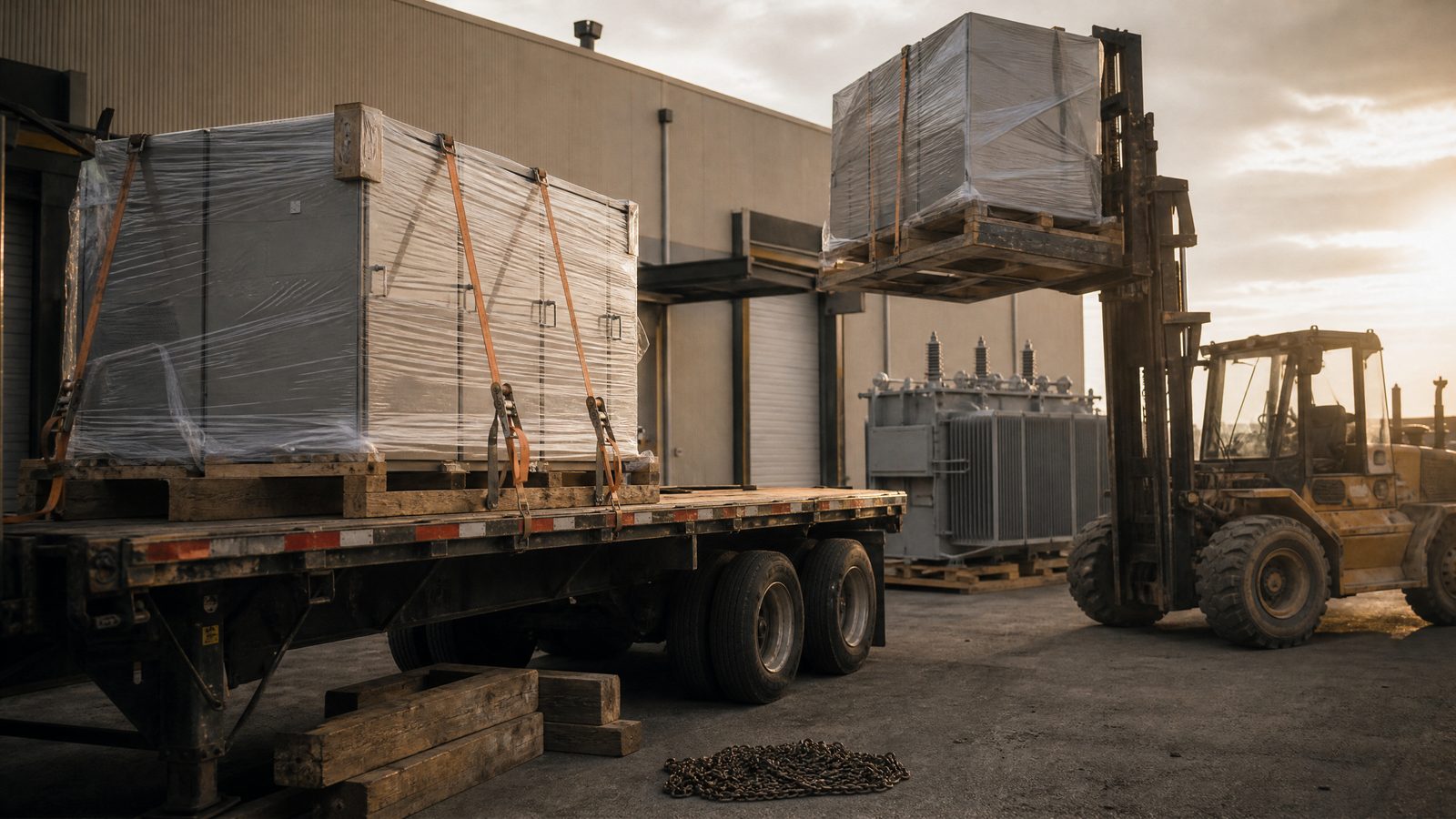
Then our crews come in with the rigging, the dollies, the plate steel and the trailers. Bus duct comes down in runs, switchgear comes apart at the section joints, transformers get skidded or craned depending on the pad.
Plate 04
4. Payment, then the trailer leaves
You are paid before the equipment leaves your property. Company check, wire or ACH — whichever your accounting department prefers. On multi-week projects we pay per load-out rather than at the end.
You get a bill of lading for everything that leaves, and where you need it, documentation for your own environmental or asset-disposal records.
Plate 05
What we need from you, and what we do not
We need a de-energized, locked-out piece of equipment, verified by your representative, and safe access to it. That is the whole list.
We do not need you to clean anything, palletize anything, disconnect anything, or arrange trucking. We do not need you to know what the equipment is worth before you call — that is our job, and telling us a number first almost never helps you.
Plate 06
Why the offer is written and itemized
A verbal number is worth nothing when a crew shows up and starts renegotiating on the floor. Every offer we write lists each lot, the price for that lot, and the removal scope attached to it.
If we find something on site that was not on the list — an extra MCC section, three hundred feet of unlisted tray cable — we write an addendum and you approve it before we take it.
Questions
Frequently asked
Do you charge for removal?
No. On any lot with recoverable value the removal cost is priced into the offer and you receive a net number. If a lot is genuinely worthless — badly burned gear, scrap-only aluminum panels in a bad location — we will tell you that instead of inventing a number.
How fast can you be on site?
A written offer comes back the same business day. Crews typically mobilize within one to two weeks, and faster on a shutdown or a demo schedule that has already been set.
Do you buy equipment that is still energized?
We buy it, but we do not touch it energized. Your electrician or the utility de-energizes and locks out, your representative verifies it, and then our crews begin.
Will you take one item or do you only do whole plants?
Both. One transformer on a pad is a legitimate call. So is a complete plant electrical lot with substations, MCC lineups, hundreds of bus plugs and miles of tray cable.
Are you insured?
Yes. General liability and workers' compensation, with certificates naming your entity and your general contractor sent before mobilization if your site requires it.
What do you do with the equipment?
Reusable gear is tested, refurbished where needed, and resold into the used-equipment market — often to plants waiting many months on new switchgear. What cannot be reused is separated into copper, aluminum, steel and electronics streams.
Form 1 — Request for Offer
Get a Written Offer
Send the asset list, or just describe what is in the room. We come back the same business day with a written, itemized offer.
Faster: call or text 954-740-1983
Email an asset list to electricalequipmentbuyers@gmail.com
Mon–Sat, 7am–7pm ET. We never resell your contact information.