
Valuation
What used switchgear is actually worth
Every switchgear valuation is the same subtraction problem: what the sections are worth to the next owner, minus what it costs to get them out of your building intact.
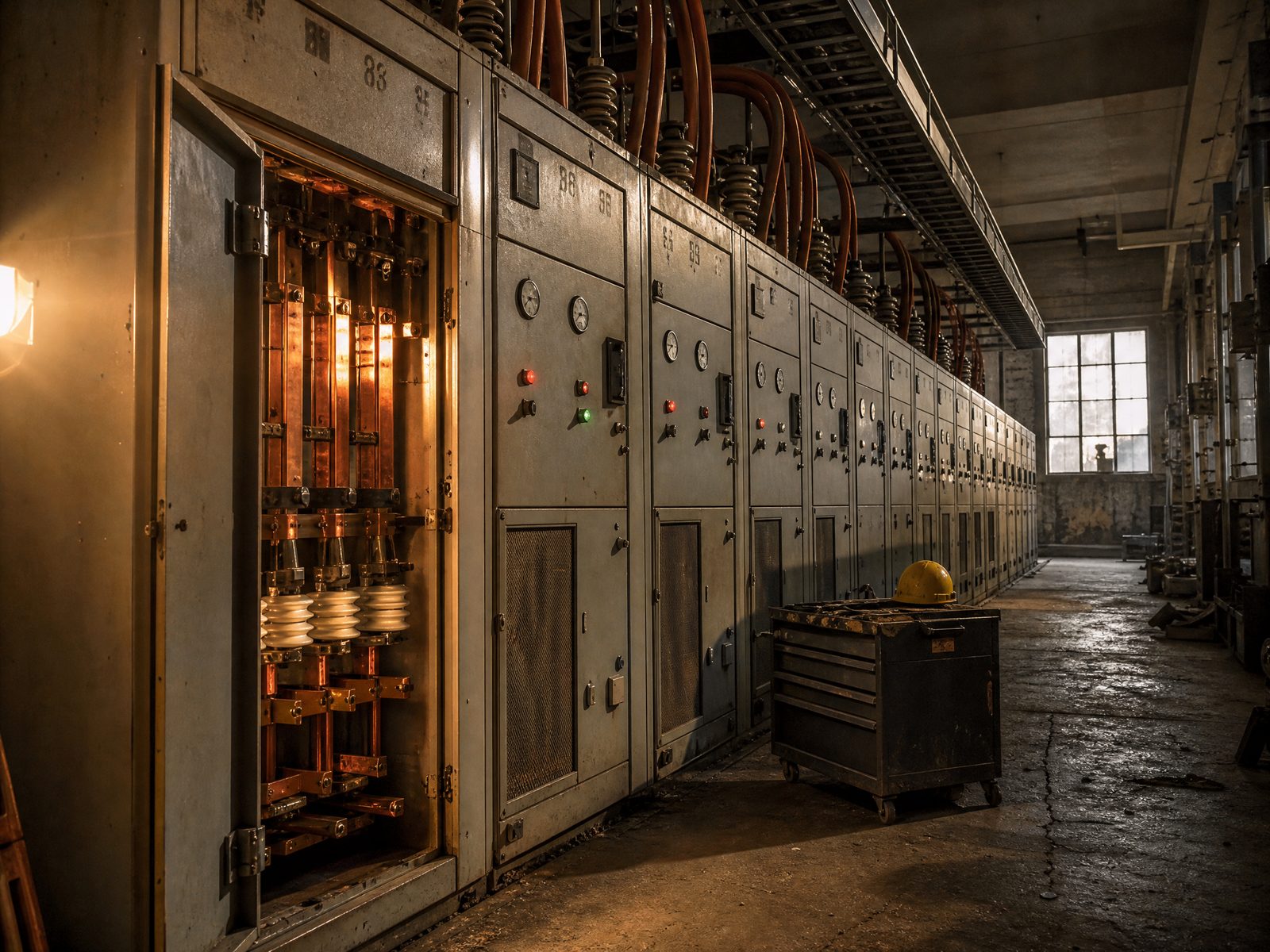
Plate 01
There are only two floors under a price
A used switchgear line-up has exactly two possible values, and the higher one wins. The first is resale value: somebody needs that make, model and rating as a working assembly, either as a spare for an identical installation or as the cheapest path to added capacity. The second is recovery value: the copper bus, the aluminum, the steel enclosure and the scrap content of the breakers, priced against the day's commodity market and the cost of processing.
Almost all of the disagreement between sellers and buyers comes from the seller pricing a line-up against the first floor while the buyer is pricing it against the second. A 1970s 5 kV line-up with obsolete air magnetic breakers and a cracked bushing is a copper transaction, and it is worth real money as a copper transaction. A 2015 vacuum-breaker line-up with a NETA report is a resale transaction and can be worth several times the metal.
When you ask what your gear is worth, you are really asking which of those two markets it lands in. The nameplate answers most of that question before anyone visits the site.
Plate 02
The five nameplate facts that move the number
Voltage class comes first. Low-voltage switchboards and 480 V switchgear have a deep, active resale market because there are hundreds of thousands of comparable installations. Medium-voltage gear at 5 kV and 15 kV has a thinner but higher-value market: fewer buyers, but the ones who exist need specific models badly enough to pay for them.
Interrupting rating and bus ampacity come next, because they determine what the gear can be reused for. A 3000 A main bus with 65 kA interrupting capacity fits far more replacement scenarios than an 800 A bus at 22 kA.
Manufacturer and model line matter more than most sellers expect. Certain discontinued lines have a permanent aftermarket because thousands of installations still run them and the factory no longer supplies parts. Obsolete does not mean worthless — it frequently means the opposite.
Breaker type is the fourth fact. Drawout vacuum and modern insulated-case breakers carry independent resale value and are often the most valuable single items in a line-up. Fixed-mounted or air-magnetic breakers usually do not.
Finally, the year of manufacture and the service history. A 1998 line-up that has been maintained and tested is a better asset than a 2008 line-up that sat in a wet vault. Anything that has taken a fault or been submerged drops straight to recovery value, and it is better for everyone if that is established before a crew mobilizes.
Plate 03
What gets subtracted
The offer you receive is net of the work required to take the gear out. That includes the electrician time to isolate and verify de-energization, the teardown labor to break a line-up into shippable sections, rigging, any structural obstacles between the gear and a truck, and the freight itself.
This is why two identical line-ups in two different buildings get different offers. Gear on a loading-dock-level slab with a clear path is cheap to remove. The same gear in a sub-basement, behind a door that has to come off its frame, up a stair with a turn in it, carries several thousand dollars of additional labor that has to come out of the purchase price.
The honest version of a valuation conversation includes that subtraction explicitly. When we send a written offer we state the removal scope alongside the number, so you can see what you are being paid for the equipment and what you are being relieved of in labor and liability.
Plate 04
What to send for a real number
Photographs of the nameplate on every section, wide shots showing the full line-up and the room around it, a photo of the path from the gear to the nearest dock or exterior door, and any test reports you have. That package is enough to price most line-ups within a few hours without anybody flying anywhere.
If you have a single-line diagram, send it. It resolves ratings, sequence and what feeds what faster than any set of photographs, and it tells a buyer immediately whether the line-up can be sold as a functional assembly or has to be split.
Questions
Frequently asked
Is old switchgear worth anything?
Frequently yes, and sometimes more than newer gear. Discontinued line-ups still running in thousands of buildings create a permanent parts market, so obsolete sections and breakers can carry strong resale value. If there is no resale market, the copper bus and breaker content still set a real floor price.
Do I have to remove the switchgear before selling it?
No. We buy in place and remove it with our own crews, including de-energization coordination, teardown, rigging and freight. Sellers who remove gear themselves usually damage it in ways that reduce its value.
How fast can I get a written offer on a switchgear line-up?
Same business day in most cases, once we have nameplate photos and wide shots of the room. Larger multi-section or medium-voltage scopes sometimes take a second day if a site visit is warranted.
Does a NETA test report increase what you can pay?
It is the single document that most raises an offer on switchgear and breakers. A current acceptance or maintenance test report lets the equipment be sold as verified working rather than as-is, which changes the market it goes into.
Next
Related field notes
Why obsolete circuit breakers can be the most valuable items in the room
Drawout breakers, discontinued frames and the aftermarket that keeps them valuable. How breaker offers are built and what documentation raises them.
ValuationThe photographs that turn an inquiry into a number
Buyers price equipment from nameplates and site context. Here are the exact photographs to take, what has to be legible, and the shots sellers almost always forget.
ProcessWhat buyers look for in 5 kV and 15 kV equipment
Metal-clad switchgear, vacuum breakers and MV motor control: why the buyer pool is small, why values are high, and what documentation is effectively required.
ValuationForm 1 — Request for Offer
Get a Written Offer
Send the asset list, or just describe what is in the room. We come back the same business day with a written, itemized offer.
Faster: call or text 954-740-1983
Email an asset list to electricalequipmentbuyers@gmail.com
Mon–Sat, 7am–7pm ET. We never resell your contact information.