
Process
How test reports change what used equipment is worth
Test reports do one thing: they move equipment from 'as-is' to 'verified'. That is the largest single jump in used-equipment pricing.
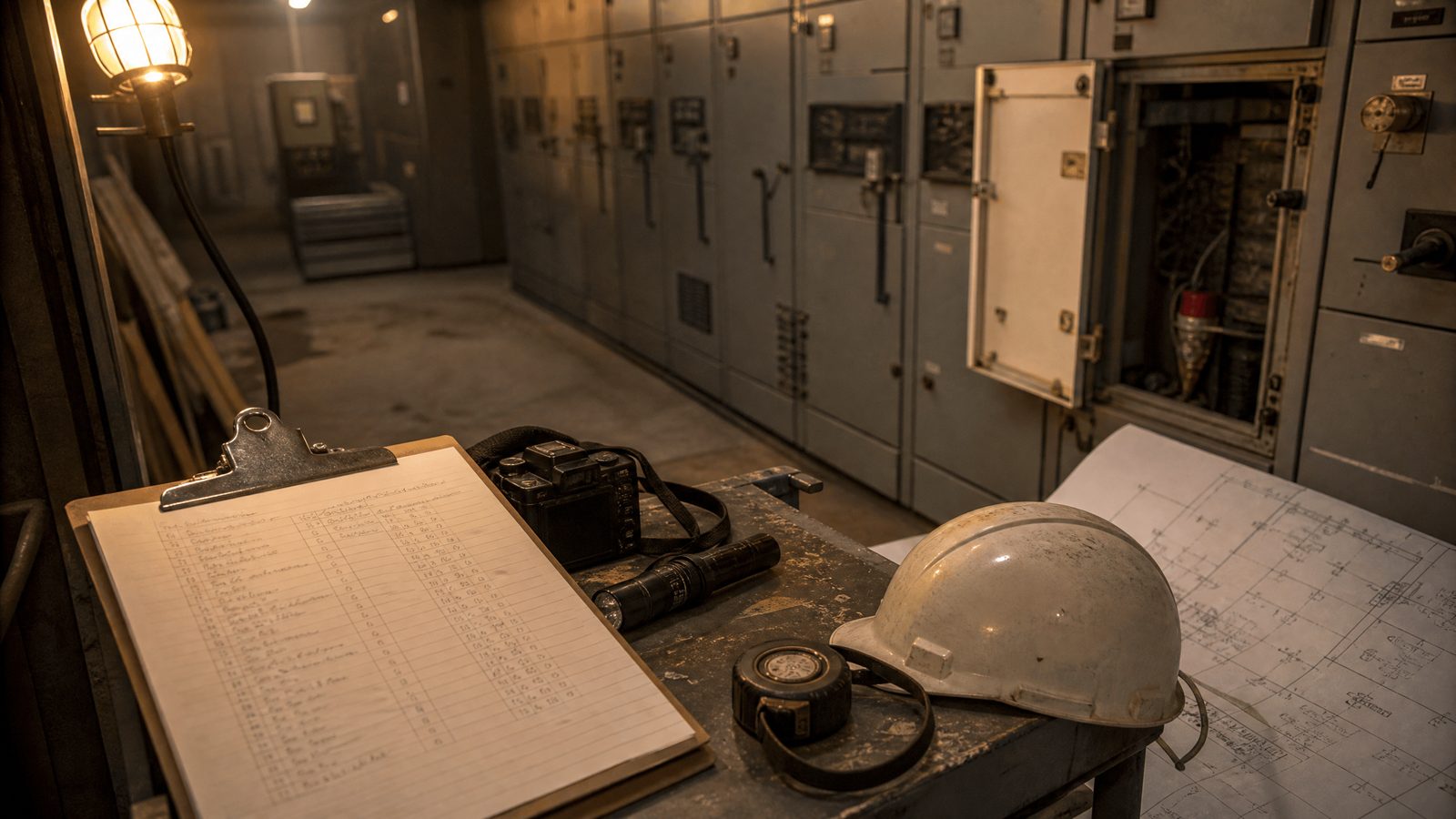
Plate 01
As-is versus verified
An untested unit is sold with all of its uncertainty priced in by the buyer, because the buyer will have to test it and may discover a problem. A unit with current test results is sold with that uncertainty resolved, which lets the buyer resell it to an end user who intends to energize it.
The end-user market pays considerably more than the dealer-to-dealer market, and test reports are the ticket into it. That is the entire mechanism.
Plate 02
Which reports matter, by equipment type
On transformers: insulation resistance, turns ratio, winding resistance, power factor, and on liquid-filled units dissolved gas analysis and oil quality. DGA in particular is the report that tells a buyer whether there is an internal fault history.
On breakers: contact resistance, insulation resistance, timing, and primary injection or trip unit verification. On switchgear line-ups: bus insulation resistance, plus the breaker reports. On generators: load bank test results, oil analysis and service history. On cable: hi-pot or VLF results where applicable.
Thermographic survey images from recent maintenance are also useful across all categories, because they document connection condition under load.
Plate 03
When to test before selling
The arithmetic is straightforward: testing is worth commissioning when its cost is small relative to the value gap between as-is and verified pricing. On a large transformer or a medium-voltage line-up, that is nearly always true. On a small panel or a molded-case breaker, it nearly never is.
If you are unsure, ask the buyer directly what the difference would be. An honest answer is available, and a buyer who declines to give one is telling you something.
Plate 04
Keep the reports with the equipment
Reports get separated from equipment constantly — filed on a server nobody can access after a closure, or left with a departing engineer. When a report cannot be produced, the equipment is untested for pricing purposes regardless of what was actually done.
Scan them, keep them with the equipment file, and send them with the inquiry.
Questions
Frequently asked
Does testing before selling actually pay off?
On higher-value equipment, frequently yes, because it moves the unit from as-is to verified pricing. On small items the testing cost usually exceeds the gain.
Which test report matters most on a transformer?
For liquid-filled units, dissolved gas analysis, because it indicates internal fault history. Insulation resistance and turns ratio matter across all types.
Do you accept older test reports?
They help, but recency matters. Reports more than a few years old with subsequent service time carry less weight than current results.
Can you arrange testing as part of the purchase?
On larger scopes, yes, we can coordinate testing where it clearly improves the outcome for both sides.
Next
Related field notes
How transformer offers are actually built
kVA, voltage, cooling class, core material and test history: the factors that separate a copper-value transformer from one worth several times its metal.
ValuationWhat buyers look for in 5 kV and 15 kV equipment
Metal-clad switchgear, vacuum breakers and MV motor control: why the buyer pool is small, why values are high, and what documentation is effectively required.
ValuationWhy obsolete circuit breakers can be the most valuable items in the room
Drawout breakers, discontinued frames and the aftermarket that keeps them valuable. How breaker offers are built and what documentation raises them.
ValuationForm 1 — Request for Offer
Get a Written Offer
Send the asset list, or just describe what is in the room. We come back the same business day with a written, itemized offer.
Faster: call or text 954-740-1983
Email an asset list to electricalequipmentbuyers@gmail.com
Mon–Sat, 7am–7pm ET. We never resell your contact information.