
Valuation
What a used diesel generator is worth, and why hours mislead
Hours are the first number every seller quotes and rarely the number that decides the price.
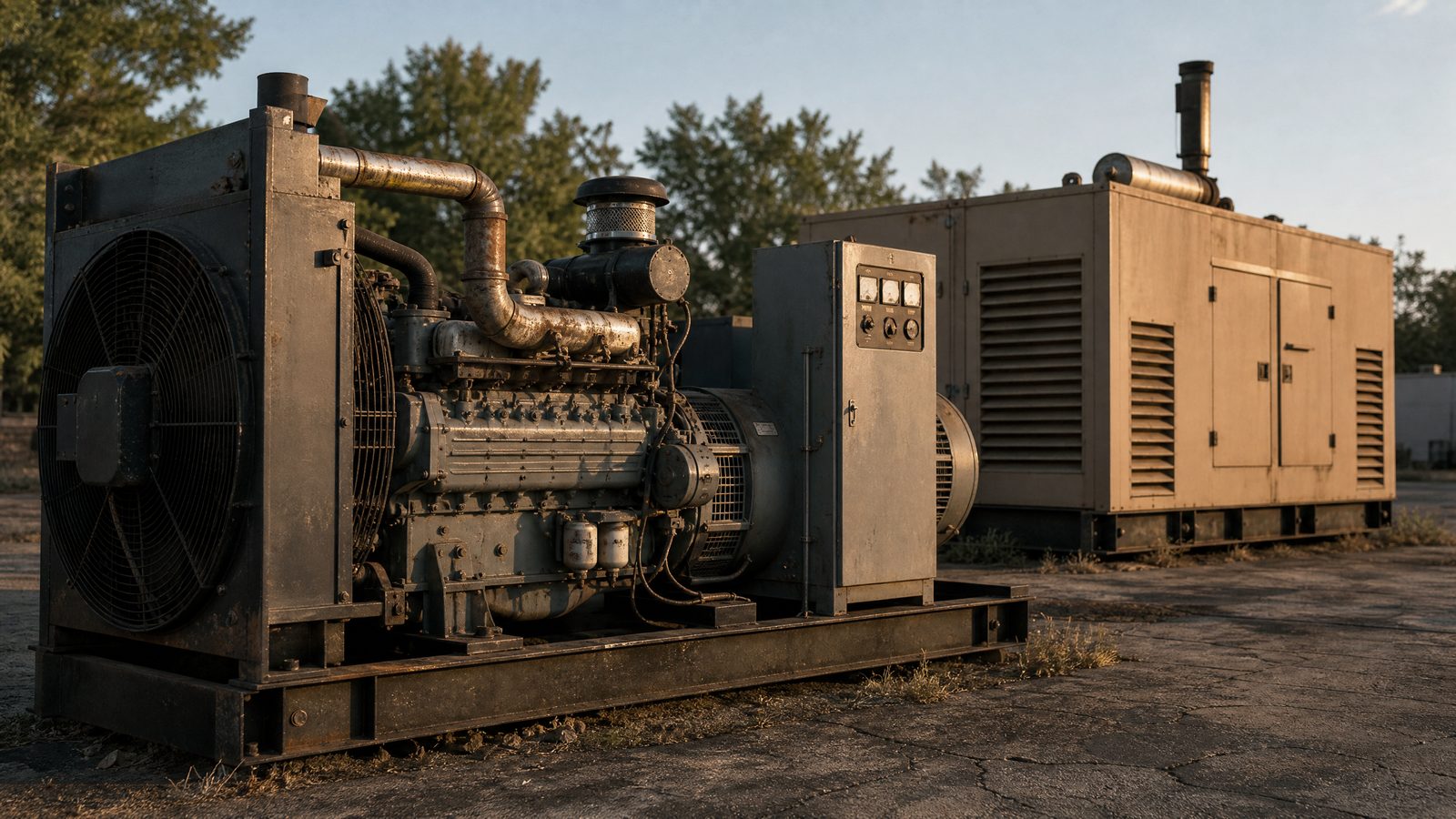
Plate 01
Rating and engine family set the market
Kilowatt rating places a set in a market. Sets from about 150 kW through 2 MW have the deepest demand because that is where commercial standby, data center and industrial backup applications cluster. Very small sets compete with cheap new production; very large sets have a narrow buyer pool.
Engine family matters as much as rating. Engines with worldwide parts support and a large installed base are far easier to place than orphaned or niche engines, regardless of condition. A well-supported engine with high hours frequently outsells a low-hour set nobody can service.
Plate 02
Standby hours versus prime-power hours
A standby set with 400 hours has almost certainly accumulated them in short monthly exercise runs, which is the hardest duty per hour there is: cold starts, light loads, incomplete warm-up. A prime power set with 8,000 hours of steady loaded operation may be in better mechanical condition.
So hours are read alongside service records, oil analysis if it exists, and evidence of how the set was maintained. A binder of service records is worth more to an offer than a low number on the hour meter.
Plate 03
What comes with it
The value of a generator package includes its enclosure, base tank, radiator, controls, breakers, transfer switches and paralleling gear. A sound-attenuated enclosure in good condition adds real money. A complete package with its ATS and switchgear sells to a wider set of buyers than a bare set on a skid.
Conversely, sets that have been partially cannibalized — missing controls, radiator, or breaker — drop sharply, because the buyer has to source parts before the set is sellable.
Plate 04
Non-runners still have a number
A seized or damaged set is priced on its alternator, its core engine value, the copper in its windings and cable, and the enclosure and tank. That is a real number, often larger than sellers expect, and it is the honest basis for pricing a set that has not started in five years.
What hurts a non-runner is uncertainty about why. If the failure history is known, say so. A documented cause is easier to price than an unexplained silence.
Questions
Frequently asked
What size generators do you buy?
Roughly 100 kW through 3 MW, diesel and natural gas, with or without enclosures, transfer switches and paralleling switchgear.
Do you buy generators that do not run?
Yes. Non-running sets are priced on alternator, engine core, copper, enclosure and tank value, which is frequently more than sellers expect.
How much do hours affect the price?
Less than most sellers assume. Duty type, engine family, parts support and service records usually matter more than the hour meter reading.
Should I sell the transfer switch with the generator?
Usually yes. A complete package including the ATS and paralleling gear appeals to more buyers and typically yields more than the pieces sold separately.
Next
Related field notes
What used load banks sell for, and to whom
Resistive versus reactive, air versus water cooled, kW capacity and control systems — how load bank offers are built and who buys them.
ValuationWhy data centers generate the best used electrical equipment
UPS replacements, PDU refreshes, generator upgrades and decommissioned halls. Why data center surplus is unusually high-quality and how it is priced.
SectorsWhat used switchgear is actually worth
How a used-switchgear buyer builds a number: resale value versus copper content, which nameplates matter, and the removal costs that get subtracted before you see an offer.
ValuationForm 1 — Request for Offer
Get a Written Offer
Send the asset list, or just describe what is in the room. We come back the same business day with a written, itemized offer.
Faster: call or text 954-740-1983
Email an asset list to electricalequipmentbuyers@gmail.com
Mon–Sat, 7am–7pm ET. We never resell your contact information.